
| Once there was an ugly duckling, With feathers all stubby and brown, And the other birds in so many words Said, “Get out of town!” Get out, get out, get out of town! |
So, he hid himself away, And he dreamed of a different day… When he’d grow up and he’d finally see A swan was what he was meant to be. |
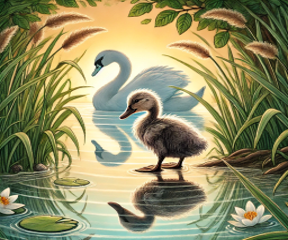 Hans Christian Andersen’s “The Ugly Duckling” is a timeless tale of transformation and self-discovery, closely related to the themes of nursery rhymes and children’s songs. It reminds us that change is not an event but a process – one that often requires patience, self-compassion, and the courage to endure periods of discomfort or doubt.
The duckling’s journey mirrors the experience of growth: the pain of being misunderstood, the isolation of feeling different, and the uncertainty of not yet knowing who or what we are becoming. But it is also a reminder that every process of change carries the promise of emergence. The duckling was never “ugly”—it was simply on its way to becoming.
What does this rhyme teach us? That our “stubby feathers” and awkward phases are not flaws but stages. That transformation takes time. And that the discomfort of not yet knowing who we are is part of the beauty of becoming.
“The Ugly Duckling,” written by Danish author Hans Christian Andersen in 1843, is a beloved tale of transformation and self-discovery. Inspired by Andersen’s childhood feelings of not belonging, the story explores themes of identity, resilience, and self-acceptance. Originally part of Andersen’s New Fairy Tales, this literary creation has become a timeless classic, symbolizing the beauty of becoming and the importance of embracing one’s true self.