
In my back yard, I have a banana plant.
Technically, I have more than one, because banana plants don’t really believe in being solitary. They grow in families, sending up new shoots from the same underground structure. Left entirely to themselves, they’ll produce as many as they can. At one point, I think we had ten.
Ten is too many.
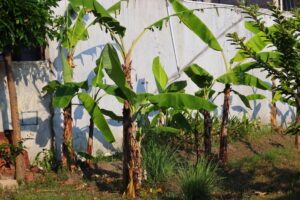
For a healthy, productive banana mat, growers often recommend keeping three generations together: one mature plant, one daughter growing behind her, and one young pup waiting her turn.
There is something wonderfully appropriate about this arrangement – the botanical equivalent of a maiden, a mother, and a crone – as we approach the end of meteorological summer and the beginning of September – a time of year when we become particularly conscious of seasons changing and one stage giving way to another.
It also makes me think about caregiving.
The maiden is our youthful selves. We aren’t quite independent yet – often we’ve barely stepped beyond our mothers’ arms. We see only the life ahead – so many possibilities. Many of us try to pretend otherwise, but we’re the ones who need care.
The mother, on the other hand, is the role many of us find ourselves in mid-life.
Maybe our children are grown, but not entirely independent. After all, caregiving doesn’t magically end when someone turns eighteen. College students and young adults till need guidance, transportation, money, reassurance, a place to land, and sometimes a parent who will answer the phone when everything has gone spectacularly wrong.
Perhaps we’re assisting our own aging parents. Suddenly the people who raised us are the ones who requiring help with technology and navigating medical systems (does there really need to be a separate portal for every different doctor?)/ They might need rides to appointments, aid around the house, companionship, or simply someone paying enough attention to notice when something has changed.
And for some of us – just like the mother banana plant – we are members of the “sandwich generation” – giving of ourselves to both the maidens and the crones in our lives.
Unlike the us, though, the banana plant doesn’t consider the middle generation an infinite resource, which brings us to the crones – our beloved elders who still possess knowledge, wisdom, and the acceptance that the end of their life is closer than the beginning.
This is why I love what happens to the oldest banana plant: a banana pseudo stem fruits only once. When it has finished, its role changes. It can be cut back, and the plant material can be returned to the earth as mulch and compost. The grandmother doesn’t simply disappear from the system. What she has accumulated becomes nourishment for the generations growing behind her.
There is something beautiful in that. There’s something almost poetic in understanding that all three generations of a banana plant share the same soil. They need water, nutrients, sunlight, and space. If too many shoots are allowed to grow at once, they begin competing for those finite resources, and eventually none of them thrives as well as it should.
Families aren’t plants, of course. But our resources are also finite.
There are only so many hours in a day. There is only so much money. There is only so much physical energy, attention, patience, and emotional bandwidth one person can provide. Love may be limitless; caregiving capacity is not.
That doesn’t mean we love anyone less. It means healthy systems require enough resources to support everyone who depends on them—including the person in the middle.
We are shaped by what previous generations leave us—not only materially, but through stories, skills, traditions, recipes, warnings, mistakes, jokes, habits, and all the tiny pieces of knowledge that become part of the soil in which a family grows.
As banana plants grow, the maiden is becoming the mother. The mother is becoming the crone. The roles aren’t fixed identities; they are places in the cycle.
Perhaps that’s what my banana plants have been trying to tell me. Caregiving isn’t supposed to be one person standing in the middle, somehow producing enough of herself to sustain everyone in both directions.
Instead, caregiving is an ecosystem, and healthy ecosystems don’t survive because one organism gives everything it has until there is nothing left.
They survive through connection, shared resources, adaptation, and renewal. They make room for what is growing, honor what has already borne fruit, and recognize that every generation is both receiving something and leaving something behind.
As the season begins to turn, maybe it’s worth considering. We are not separate plants competing for the same patch of earth; we are generations growing from the same soil.
Improv Invitation:
Think about your own family—biological, chosen, or both—as a garden. Who is growing? Who is carrying the greatest load right now? Who has wisdom or resources to return to the soil? Then consider one thing that could be added to your family’s ecosystem this week—help, rest, attention, information, companionship—to give everyone a little more room to thrive.